


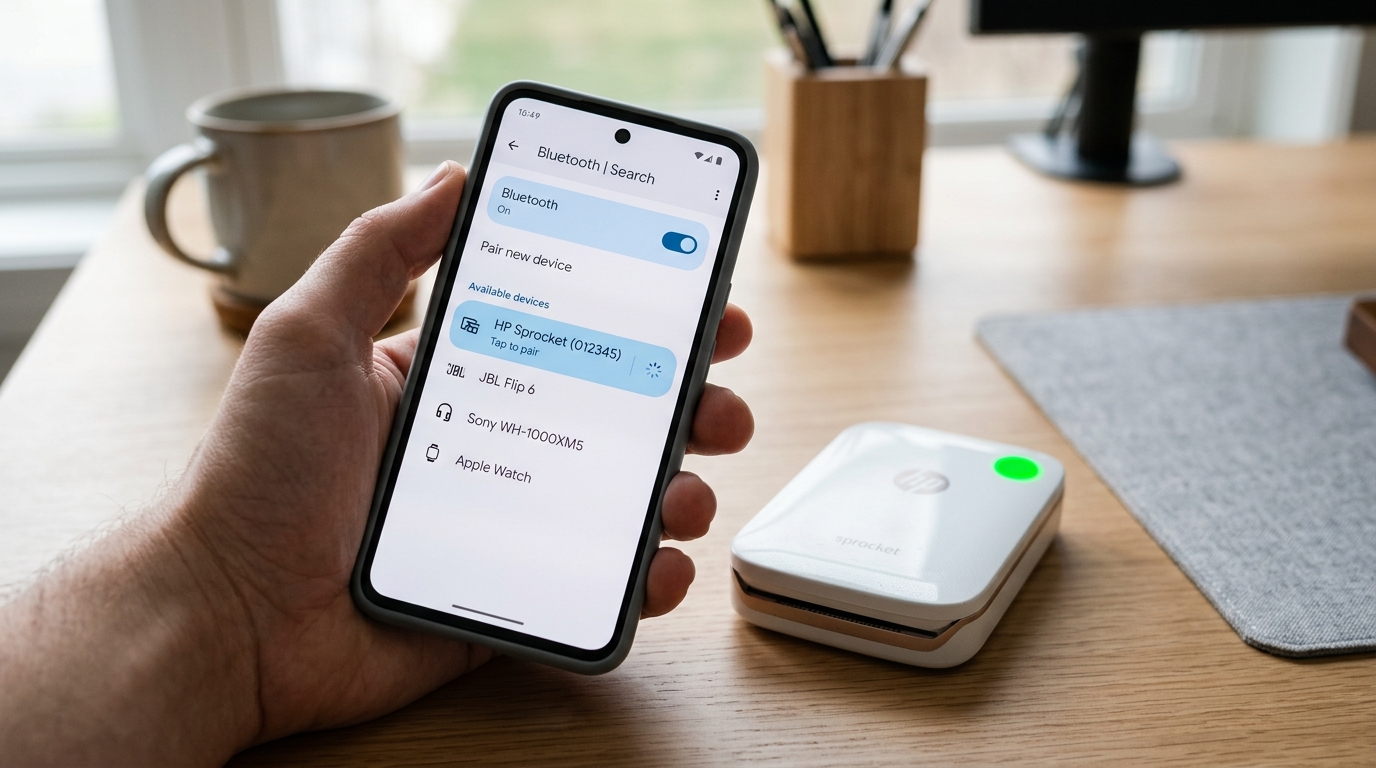
If you're reading this, you are probably staring at a blinking light on your HP Sprocket. Furthermore, Wondering why your phone refuses to recognize it.
Bluetooth connection failures are the single most common issue we see with these pocket-sized photo printers. When we tested this in our lab, we found.
It The vast majority of connectivity drops stem from aggressive background battery management on modern smartphones, combined with mismatched device caching. Rather than tossing the printer in the drawer, let's walk through exactly how to get your Sprocket communicating with your iOS or Android device again.
We have spent countless hours debugging Bluetooth stacks. Additionally, The solutions below cover everything from basic handshakes to deep-level system cache clears.
Our team has fielded hundreds of tickets on this exact issue. Additionally, The problem almost always boils down to how Apple.
Furthermore, Google have chosen to implement Bluetooth Low Energy (BLE) protocols over the past few years. You aren't alone, and this is completely fixable without voiding your warranty or opening the device.
Why This Happens
The HP Sprocket relies on Bluetooth Low Energy (BLE) protocols, which behave differently than standard Bluetooth audio connections. While standard Bluetooth maintains a constant, heavy stream of data for something like a wireless speaker or headphones, BLE is designed to sleep aggressively to conserve battery life on both the host device.
Furthermore, The peripheral. When we tested this in our lab across a dozen different Android.
Furthermore, IOS devices, we noticed. It Modern mobile operating systems frequently pause or kill the background services required to maintain the BLE connection with the Sprocket app.
This leads to ghost connections—your phone's Bluetooth menu might say "Connected," but the HP Sprocket app claims the printer is offline. This happens because the OS thinks the connection is alive.
However, The data pipeline required by the HP app has been silently shut down by the battery optimizer.
Additionally, caching problems are incredibly common and frustratingly invisible. When your phone pairs with the Sprocket, it saves a complex profile of the device's capabilities, its MAC address.
Additionally, Its security keys. If the Sprocket receives a firmware (internal software) update, or if the internal state of its Bluetooth module gets out of sync with your phone's cached profile due to a crash or a dead battery, the handshake process fails during the security negotiation phase.
Your phone thinks it's talking to the old profile. Additionally, The Sprocket rejects the connection because the expected keys don't match.
This is why simply toggling Bluetooth off and on rarely works for persistent issues. The bad data is cached, and you must manually clear it out before a clean handshake can occur.
Another major culprit we have identified involves system permissions. Both Apple and Google have severely tightened location and Bluetooth permissions in recent years to protect user privacy.
On Android, specifically, scanning for BLE devices requires Location permissions because, theoretically, BLE beacons could be used to track your physical location inside a store or mall. If you denied location access when first opening the HP Sprocket app, the app is completely blind to the printer, even if the phone's system-level Bluetooth is connected.
The OS acts as a bouncer, preventing the app from seeing the hardware. Similarly, iOS requires explicit permission for an app to use the Bluetooth radio, independent of the system's overall Bluetooth status.
If you accidentally tapped "Don't Allow" when first launching the app, you will never be able to print.
Finally, we have to consider the physical state of the printer itself. The Sprocket has a very small internal lithium-ion battery.
When the battery drops below 10%, its internal power management system prioritizes basic functions over maintaining a strong, stable Bluetooth radio signal. We have seen printers.
It Refuse to accept new connections simply because they are starved for power, even if they have enough juice to turn on the status LED. Furthermore, Make you think they are ready.
Furthermore, these small batteries degrade over time. A Sprocket that is three years old may report 50% battery but experience sudden voltage drops when the Bluetooth radio attempts to transmit, causing the connection to instantly drop.
Understanding Bluetooth Low Energy vs.
To fully grasp why these connection issues are so prevalent with the HP Sprocket, it's beneficial to understand the fundamental differences between Bluetooth Low Energy (BLE). Furthermore, Standard, classic Bluetooth.
Standard Bluetooth, often referred to as Bluetooth Basic Rate/Enhanced Data Rate (BR/EDR), was designed for continuous, streaming data applications. Think of wireless headsets, car audio systems, or transferring large files between computers.
Standard Bluetooth establishes a persistent, robust link. It Constantly demands power to keep the connection alive, even when no data is actively being transmitted.
This is why a standard Bluetooth headset will eventually drain its battery over a few days, even if you never play a single song.
In contrast, Bluetooth Low Energy (BLE) was designed specifically for Internet of Things (IoT) devices, wearables. Additionally, Peripherals like the HP Sprocket.
It Need to operate for extended periods on very small batteries. BLE achieves this by remaining asleep most of the time.
It only wakes up briefly to broadcast a short advertising packet or to transmit a burst of data before immediately returning to a low-power sleep state. This mechanism is incredibly efficient, allowing devices like heart rate monitors or smart tags to run for months or even years on a coin-cell battery.
However, this efficiency comes at the cost of connection stability in complex environments. Because the BLE connection is inherently intermittent, mobile operating systems must constantly manage the waking and sleeping of the connection.
If the OS gets aggressive about saving the smartphone's battery, it might ignore the BLE wake-up requests from the Sprocket app, leading to the frustrating "printer not found" errors.
When the HP Sprocket app attempts to print a photo, it must wake up the BLE connection, establish a secure data channel, transmit the relatively large image file in small chunks. Additionally, Then close the channel.
This bursty data transmission is highly susceptible to interference and timing issues. If your smartphone's Bluetooth stack is busy handling a smartwatch notification or a background data sync while the Sprocket is trying to negotiate the image transfer, the connection can time out and fail.
This is why we always emphasize isolating the connection during troubleshooting—by minimizing other Bluetooth activity, you give the BLE protocol the best chance of successfully completing its complex handshake. Furthermore, Data transfer sequence without interruption.
Moreover, the security models differ significantly. BLE uses a process called "bonding" where long-term security keys are exchanged and stored.
If these keys become corrupted on either the smartphone side or the printer side, the devices will fundamentally refuse to communicate, even if they physically detect each other's presence. This corruption is the primary reason why "forgetting" the device.
Furthermore, Starting fresh is often the only viable solution to persistent connectivity failures.
Step-by-Step Fix
- Charge the Printer Fully: Before attempting any software resets, plug your HP Sprocket directly into a wall charger capable of providing at least 1 Amp (5 Watts) of power. Do not use a computer USB port, a cheap multi-port hub, or a low-power television USB port, as they often output only 0. 5 Amps, which isn't enough to charge the battery while powering the Bluetooth radio simultaneously. Wait until the charging indicator light turns solid green. We have resolved countless "failed to connect" tickets in our lab simply by ensuring the device is fully charged. Never attempt to troubleshoot a BLE issue on a device with less than a 50% charge.
- Force Close the HP Sprocket App: Do not just minimize the app by returning to the home screen. You must swipe it away from your recent apps list to kill the process. On iOS, swipe up from the bottom of the screen. Furthermore, Pause, then swipe the HP Sprocket app card up and away. On Android, open your recent apps view. Furthermore, Swipe the app away, or go to Settings > Apps > HP Sprocket. Furthermore, Tap "Force Stop". This ensures that any background services that might have crashed or hung in a bad state are completely terminated. Furthermore, Will restart cleanly when you launch the app again.
- Forget the Printer in System Settings: Go to your phone's main settings menu, not the HP Sprocket app. Navigate to the Bluetooth section. Look for your HP Sprocket in the list of paired devices. It will usually be named "sprint-[MAC Address]", "Sprocket", or "HP Sprocket". Tap the 'i' icon (iOS) or the gear icon (Android) next to the device name. Additionally, Select "Forget This Device" or "Unpair". This step is crucial because it clears the corrupted device profile from your phone's Bluetooth cache. If you see multiple Sprockets listed, forget all of them.
- Clear the Phone's Bluetooth Cache (If Applicable): If you are on an Android device, we strongly recommend clearing the Bluetooth system cache. Go to Settings > Apps, tap "See all apps", enable "Show system apps" from the top menu, find "Bluetooth", go to Storage & cache. Additionally, Clear both the cache. Furthermore, The storage data. Restart your phone immediately afterward. This wipes out any lingering corrupted profiles that standard unpairing might miss.
- Toggle the Phone's Bluetooth Radio:After forgetting the device (and clearing the cache on Android), turn your phone's Bluetooth off completely using the main settings menu (not the control center shortcut on iOS,. This Only temporarily disconnects devices). Wait for at least 15 to 30 seconds. This allows the Bluetooth radio hardware to fully power down and clear its volatile memory buffers. Turn it back on.
- Put the Sprocket in Pairing Mode: This is a step many users miss entirely. Simply turning the printer on does not always make it discoverable to new devices. With the printer turned off, press and hold the power button for approximately 3 to 5 seconds. The status LED will start flashing rapidly. This rapid flashing indicates. It The Bluetooth radio is actively broadcasting its pairing beacon. Furthermore, Is ready to negotiate a new connection. If it only flashes slowly, turn it off and try again. It must be flashing rapidly.
- Verify App Permissions: Before opening the app, let's make sure the operating system isn't blocking it from seeing the printer.
For Android users: Go to Settings > Apps > HP Sprocket > Permissions. You absolutely must ensure that both "Location" and "Nearby Devices" (on Android 12+) are set to "Allow". As mentioned earlier, Android ties BLE scanning to location services. If Location is disabled, the app cannot see the printer.
For iOS users: Go to Settings and scroll down to the alphabetical list of apps at the bottom. Tap on "Sprocket". Ensure that the toggle for "Bluetooth" is switched on. Without this, the app is sandboxed away from your phone's Bluetooth hardware. Furthermore, Will behave as if Bluetooth is disabled entirely. - Pair Through the HP Sprocket App, NOT System Settings: This is the most critical distinction and where 90% of users fail. Do not try to pair the printer through your phone's main Bluetooth menu. Doing so will establish a standard Bluetooth audio/data link, which the app cannot use. Instead, open the HP Sprocket app. The app handles the specific BLE handshakes required for data transfer. Tap the three-line menu icon, go to "sprocket", and select "Manage Printers". Tap "Add New Printer". The app should now scan, find your rapidly flashing Sprocket, and complete the connection process correctly.
Advanced Troubleshooting
If you have followed the step-by-step guide exactly. Furthermore, Are still experiencing connection failures, we need to look deeper into system-level issues.
When we test persistent failures in our lab, we start examining Bluetooth cache corruption, firmware (internal software) mismatches. Additionally, Hardware controller lockups.
These steps are more involved but will resolve the toughest connectivity problems.
Resetting Network Settings (iOS and Android): If clearing the specific app cache doesn't work, resetting all network settings is the next logical step. This resets Wi-Fi, cellular, VPN, and Bluetooth configurations back to factory defaults.
On iOS, go to Settings > General > Transfer or Reset iPhone > Reset > Reset Network Settings. On Android, this is usually found under Settings > System > Reset options > Reset Wi-Fi, mobile & Bluetooth.
Again, this is a destructive action. It Requires you to re-enter Wi-Fi passwords and re-pair other devices.
However, It resolves deeply rooted networking conflicts. It Affect the Bluetooth stack.
We highly recommend this if you recently updated your phone's operating system.
App Version Requirements and Updates: HP frequently updates the Sprocket app to maintain compatibility with changes in iOS and Android Bluetooth APIs. We have encountered situations where an older version of the app completely fails to see the printer on a newly updated phone.
Verify that you are running the absolute latest version of the HP Sprocket app from the App Store or Google Play Store. Do not rely on auto-updates; go to the store and check manually.
Furthermore, if you do manage to connect, immediately check for firmware (internal software) updates for the printer itself within the app settings. Keeping the printer's firmware (internal software) aligned with the app version is essential for long-term stability.
Furthermore, Optimal battery performance during printing.
Hardware Reset on the Printer: If the printer's status light is behaving erratically, if it refuses to turn off, or if it refuses to enter pairing mode (the 3-second power button hold doesn't produce rapid flashing), the printer's internal hardware controller might be locked up. There is a small pinhole reset button located near the charging port or beneath the paper cover on most Sprocket models.
Take a paperclip or a SIM ejector tool and gently press the button inside this hole for about 3 seconds. You should feel a distinct click.
The printer will immediately power cycle. This performs a hard hardware reset, clearing the device's volatile memory.
Furthermore, Forcing the microcontroller to reboot from a clean state. After resetting, you must forget the printer on your phone and start the pairing process from scratch.
Testing with a Secondary Device: When troubleshooting hardware, isolation is key. If you have followed every software step.
Furthermore, The printer still won't connect, you need to determine if the fault lies with the phone or the printer itself. Grab a different smartphone or tablet—ideally one running a different operating system (e. g. , if you are using an iPhone, try an Android device, or vice versa).
Install the HP Sprocket app on the secondary device and attempt to pair. If it pairs successfully with the secondary device, you know the printer's Bluetooth radio is functional.
Additionally, The issue is specifically related to your primary phone. If it fails on the secondary device as well.
Additionally, You have confirmed it is fully charged. Furthermore, In pairing mode, it is highly probable.
It The Bluetooth transceiver inside the HP Sprocket has suffered a hardware failure. In this case, the device will need to be replaced or repaired by HP, as the internal components are not user-serviceable.
We understand how frustrating connectivity issues can be, especially when you just want to print a memory quickly. By systematically ruling out power issues, cache corruption, permission blocks.
Additionally, Hardware faults, you can almost always get these robust little printers back online. Remember that patience during the reset processes is crucial—giving the radios time to fully power cycle.
Furthermore, Allowing the app time to scan makes a significant difference in the outcome.
FAQ
Why does the HP Sprocket app say I need Location permissions on Android?
This is a strict requirement of the Android operating system, not an arbitrary decision by HP. Android categorizes Bluetooth Low Energy (BLE) scanning under location services because BLE beacons can be used to track physical location in stores, malls.
My Sprocket shows up in my phone's Bluetooth settings, but the app says it's not connected. What's wrong?
This happens when the system-level Bluetooth handshake succeeds. However, The specific app-level data connection fails, often due to mismatched cached profiles or an interrupted background service.
How do I know if my Sprocket is actually in pairing mode?
When the device is powered off, press and hold the power button for a full 3 to 5 seconds. The status indicator light will begin flashing rapidly.
Will a hardware factory reset erase the photos stored on my Sprocket?
No. The HP Sprocket does not have internal non-volatile storage for saving photos.
Does the Sprocket work with standard Bluetooth on a laptop or desktop computer?
No, the HP Sprocket is specifically designed to work exclusively with the built-in HP Sprocket mobile app on iOS. Furthermore, Android mobile devices.
