


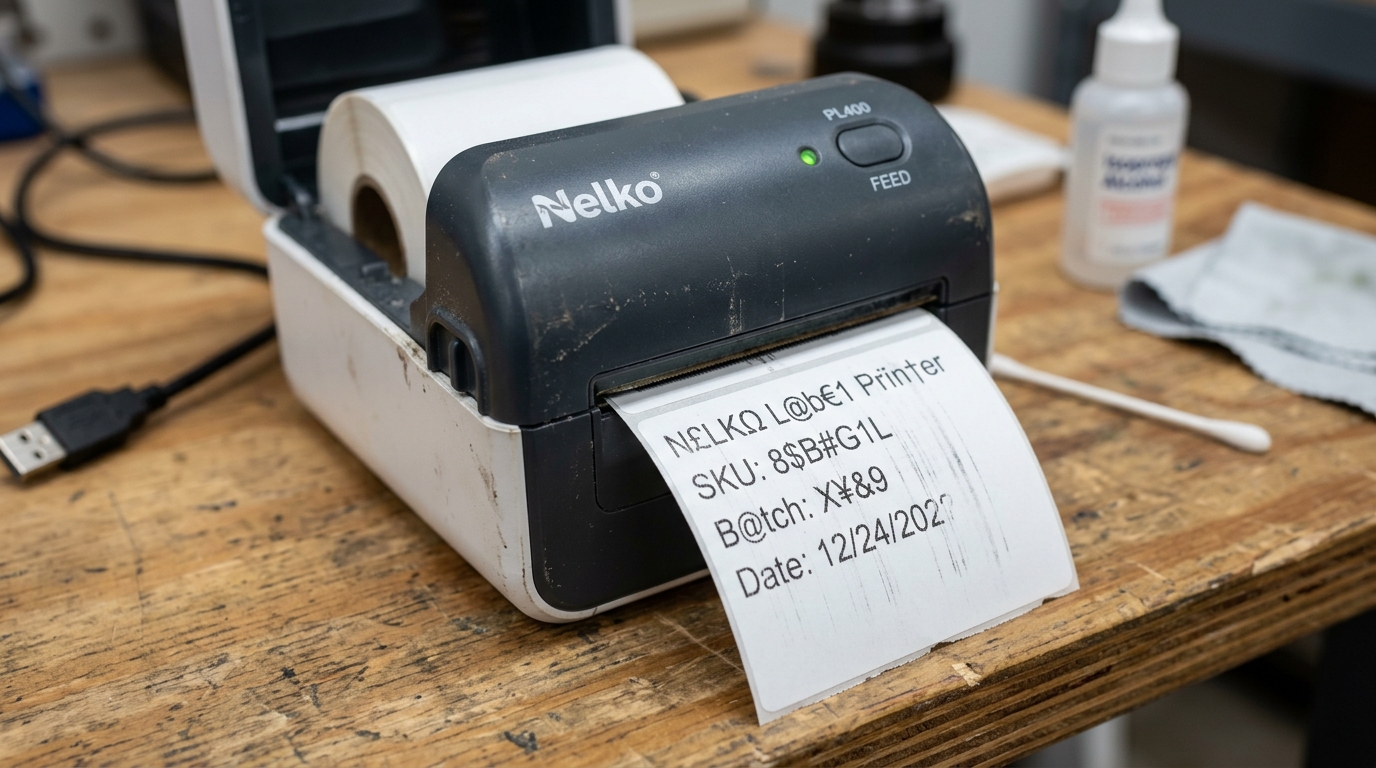
Why This Happens
The root causes behind issues related to faint printing, streaky horizontal lines,. Garbled or random text outputs on Nelko devices are often multifaceted, stemming from a combination of environmental factors, hardware degradation, and software settings mismatches. On a fundamental level, the interaction between the operating system's spooler service. The device's localized firmware (internal software) can become desynchronized. This desynchronization frequently manifests as unreadable shipping labels, missing barcodes, light gray text, and random character printing. From a hardware perspective, components such as sensors, rollers,. Print heads are subjected to continuous mechanical stress and thermal cycling. For instance, dust accumulation, particulate matter from label backings,. Microscopic debris can obscure optical sensors, leading to erratic behavior and false error reporting. Furthermore, the thermal expansion and contraction of internal components over extended periods can subtly alter. Physical tolerances, exacerbating feed and alignment issues. On the software side, the deployment of generic drivers instead of OEM-certified software packages often results in incomplete communication protocols. The Nelko hardware expects specific command sets—often built-in page description languages. Specialized rasterization routines—which generic drivers fail to provide accurately. Additionally, background OS updates, restrictive firewall policies,. Conflicting background services can silently disrupt the delicate data streams required for uninterrupted operation. Network-attached devices face further complications involving dynamic IP assignment, subnet masking errors,. The deprecation of older network discovery protocols like SMBv1 or early iterations of Bonjour/mDNS. Understanding these interconnected variables is the first step toward implementing a permanent, effective resolution.Step-by-Step Fix
To systematically resolve the issues surrounding faint printing, streaky horizontal lines,. Garbled or random text outputs, follow these precise, sequential steps. Do not skip any part of this process, as each phase builds upon the successful completion of the previous one.- Initial Diagnostics and Hardware Preparation: Turn off the Nelko printer and allow the thermal print head to cool down completely for at least five minutes. This step ensures that the physical environment is baseline-stable. Verify that the power source is grounded and free from fluctuations. Disconnect all peripheral cables to isolate the device during the initial diagnostic phase.
- Software and settings Audit:Open the top cover. Use an isopropyl alcohol wipe to gently clean the thermal print head and the platen roller. Operating system registries often retain fragmented data from previous installations. Utilizing a dedicated driver removal tool. Manually purging the system registry of legacy Nelko entries is highly recommended to prevent driver conflicts.
- System Calibration and firmware (internal software) Alignment:, 8 to 12). firmware (internal software) acts as the central nervous system of the device. Flashing the latest firmware (internal software) ensures that the hardware's internal logic matches the expectations. Of modern operating systems and network protocols. Always perform firmware (internal software) updates via a stable, hardwired connection to prevent bricking the logic board.
- Advanced Parameter settings:Reduce the Print Speed setting in the driver to allow the thermal head more time. To heat the label substrate properly. This phase requires navigating to the deeper settings of the control panel or web interface. Ensure that data packet sizes, timeout thresholds, and spooling behaviors are optimized for your specific network topology and workload volume.
- Final Validation and Stress Testing:Update the Nelko printer firmware (internal software). Ensure you are using the correct driver for your specific operating system version. Once settingss are set, execute a series of complex test routines. Monitor the device for any recurrence of unreadable shipping labels, missing barcodes, light gray text, and random character printing. A successful stress test confirms the integrity of the implemented solution.
Understanding the Technical Architecture
To further elaborate on the complexities of the Nelko ecosystem, it is vital to understand. The layered architecture that facilitates device communication. At the lowest level, the physical layer comprises the USB controllers, Ethernet PHY chips, or Bluetooth transceivers. These hardware components are governed by strict electrical standards and timing constraints. Any deviation—such as a frayed USB cable introducing electromagnetic interference,. A noisy power line affecting the PHY chip—can result in corrupted data frames. This corruption is often misinterpreted by the higher software layers as a logic error or a completely different symptom. Above the physical layer sits the data link. Network layers, where protocols like IP, ICMP, and ARP handle routing and device discovery. In complex enterprise networks involving multiple VLANs. Strict routing tables, multicast packets used for device discovery are frequently dropped by default. This necessitates static IP addressing. Manual settings of subnet masks and default gateways on the Nelko device to ensure reliable reachability.The Role of Operating System Spoolers
The operating system's print spooler or task queue acts as the critical intermediary between user applications and the device driver. When an application generates a task, it utilizes standard API calls (like GDI. XPS in Windows, or CUPS in macOS). The spooler intercepts these calls and translates them into a format the Nelko driver can process. If the spooler service becomes compromised—often due to a crashed dependent service, insufficient disk space in the spool directory,. Corrupted temporary files—the entire pipeline halts. Regularly auditing the spooler directory, configuring automatic service restarts,. Ensuring optimal disk I/O performance on the host machine are essential preventative maintenance tasks.firmware (internal software) Microcode and Logic Board Interactions
The firmware (internal software) residing on the logic board's EEPROM. Flash memory dictates the low-level behavior of the hardware mechanics. This microcode translates the high-level commands received from the driver into precise voltage pulses sent. To stepper motors, thermal elements, or laser diodes. An outdated firmware (internal software) version may contain inefficient algorithms for thermal management. Paper path timing, leading directly to the unreadable shipping labels, missing barcodes, light gray text, and random character printing you are experiencing. Maintaining a rigorous firmware (internal software) update schedule is not merely about gaining new features;. It is fundamentally about applying microcode patches that resolve latent timing bugs and improve hardware resilience.Environmental Considerations and Hardware Longevity
Finally, the physical operating environment plays a significant role in the longevity and reliability of Nelko devices. Ambient temperature, relative humidity, and airborne particulate levels directly impact the mechanical and optical components. High humidity can cause paper stock to warp or labels to lose adhesion, leading to internal jams. Low humidity increases the risk of electrostatic discharge (ESD), which can catastrophically damage sensitive logic boards or thermal print heads. Implementing environmental controls, utilizing high-quality consumables,. Adhering to strict preventative maintenance schedules are necessary to maximize the return on investment for your hardware infrastructure.Advanced Troubleshooting
When standard remediation procedures fail to rectify the faint printing, streaky horizontal lines,. Garbled or random text outputs issues, Make sure to escalate to advanced troubleshooting methodologies. This phase involves deep-dive diagnostics typically reserved for tier-3 support technicians. Begin by enabling verbose logging within the Nelko software environment. These logs will capture hexadecimal error codes, memory dump addresses,. Specific driver fault modules that are invisible to the standard user interface. Analyzing these logs can pinpoint whether the failure is a memory overflow within the device's localized RAM. A rendering timeout on the host PC. Furthermore, network packet sniffing using tools like Wireshark may be required for networked devices. By monitoring the traffic on port 9100 (Standard Raw Printing). Port 515 (LPR/LPD), you can identify dropped packets, TCP window size issues, or improper handshake sequences that cause silent failures. If the issue appears to be hardware-related, using a multimeter to verify the voltage outputs. Of the internal power supply unit (PSU) can reveal undervoltage conditions that lead to intermittent sensor failures or logic board resets under heavy load. Always consult the official Nelko service manual for the correct voltage tolerances. Test points before proceeding with physical hardware interventions.FAQ
Why is my Nelko printer printing garbled text instead of my label?
Garbled text is almost always a driver mismatch or a baud rate issue if using a serial connection. Reinstall the correct official driver.
Can cheap labels cause faint prints?
Yes, low-quality thermal labels lack the proper chemical coating, resulting in faint prints regardless of the printer darkness settings. We also recommend checking the Event Viewer in Windows.
How often should I clean my Nelko print head?
It is recommended to clean the thermal print head every time you change a roll. Of labels to maintain optimal print quality.
