

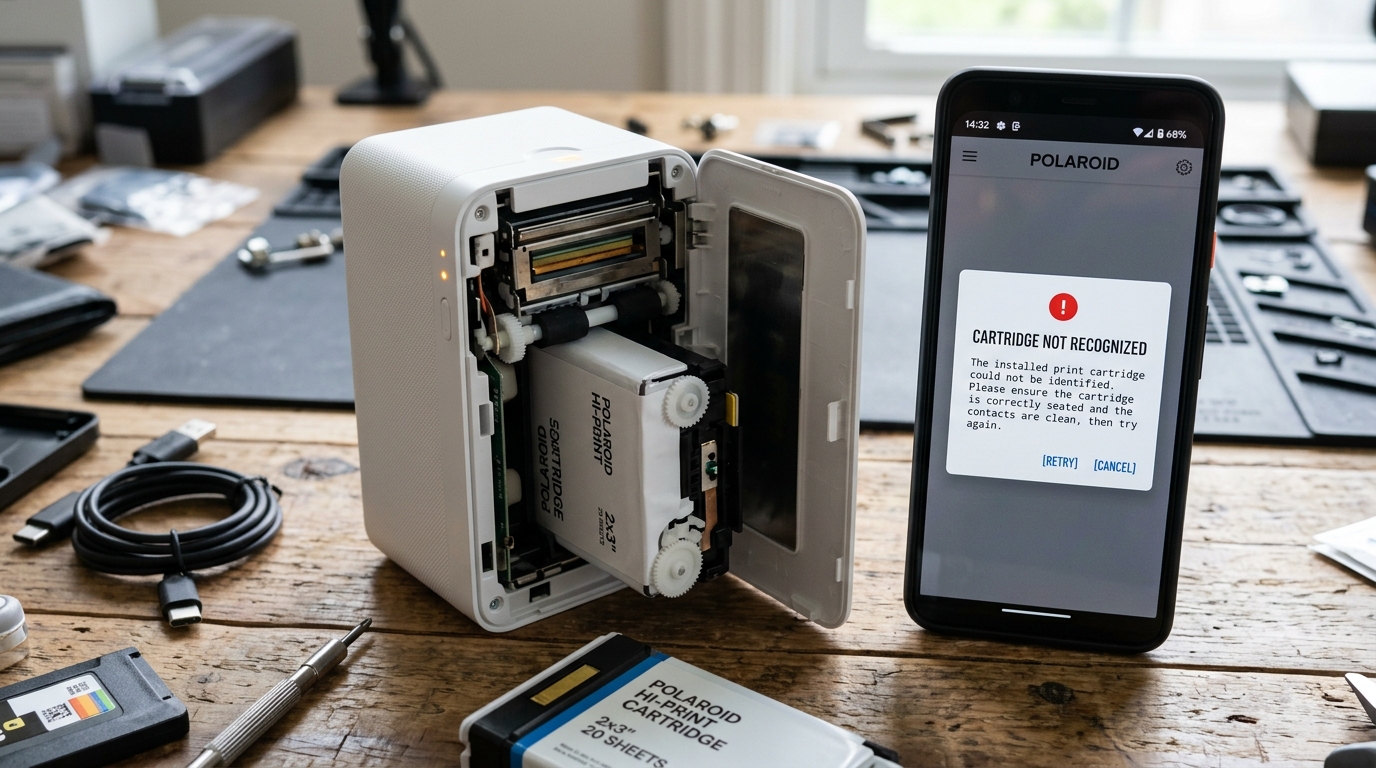
The Polaroid Hi-Print is beloved for its dye-sublimation technology, which produces high-quality, water-resistant, and smudge-proof sticker prints. However, the experience can quickly turn frustrating when the printer fails to recognize the all-in-one paper.
Furthermore, Ribbon cartridge, displaying an ominous "Cartridge Not Recognized" or a false "Paper Out" error on the companion mobile app. This issue effectively bricks the printer until resolved, preventing any photos from being processed.
Because the Hi-Print relies on a built-in cartridge system where the paper. Furthermore, The dye ribbon are housed together, a failure in the printer's ability to read or mechanically engage with this cartridge is a critical failure point.
This comprehensive guide will explore the technical reasons behind these specific cartridge errors. Furthermore, Provide a rigorous, step-by-step troubleshooting process to help you get your Polaroid Hi-Print recognizing its media.
Furthermore, Printing flawlessly once again.
Why This Happens
The communication between the Polaroid Hi-Print. Furthermore, Its cartridge relies on a combination of mechanical alignment, optical sensors. Additionally, Sometimes basic electronic contacts. When a "Cartridge Not Recognized" or "Paper Out" error occurs despite a cartridge being inserted, it points to a failure in one of these interconnected systems.
The most frequent cause is improper physical seating of the cartridge. The Hi-Print has tight tolerances.
If the cartridge is inserted at a slight angle, not pushed in completely until it clicks, or if debris is preventing a flush fit, the internal sensors will not trigger correctly. The printer's logic board will read this as an empty bay, resulting in the error.
This is especially common for new users who may be hesitant to apply the necessary pressure to seat the cartridge firmly.
Another major culprit is issues with the dye ribbon within the cartridge itself. The dye-sublimation process requires the ribbon to be perfectly taut.
If the ribbon develops slack, gets twisted during shipping, or is accidentally pulled, the printer's internal gears cannot properly engage with the cartridge spools. When the printer attempts its initial calibration spin upon loading, a slack ribbon will cause a mechanical fault, prompting the printer to reject the cartridge.
Furthermore, Display an error to prevent a catastrophic jam.
Sensor obstruction or failure is a less common but more serious issue. The printer uses small optical sensors to detect the presence of the paper stack.
Furthermore, The positioning markers on the dye ribbon. If dust, lint, or a tiny scrap of paper falls into the printer cavity.
Furthermore, Blocks these sensors, they will falsely report. It The printer is empty.
In worse cases, a sensor may be defective or misaligned from the factory, or damaged by a previous paper jam.
Finally, firmware (internal software) glitches can sometimes misinterpret sensor data. A bug in the printer's internal software might cause it to incorrectly read a perfectly good cartridge as invalid.
This is why keeping the printer updated via the app is crucial, as manufacturers often release patches to improve cartridge recognition logic. Furthermore, Sensor sensitivity.
Step-by-Step Fix
- Remove and Inspect the Cartridge: First, open the side door of the printer and remove the offending cartridge. Examine it closely. Look at the exposed dye ribbon. It should be perfectly flat and taut across the opening. If it is wrinkled, twisted, or sagging loosely, this is likely the cause of the error.
- Tighten a Slack Ribbon: If the ribbon is slack, you can often fix it manually. Look at the side of the cartridge; you will see a small, geared wheel (usually the take-up spool). Very gently, turn this wheel in the direction. It Tightens the ribbon (usually indicated by a small arrow or by observing. This Way pulls the ribbon taut). Do not over-tighten; just remove the slack until it is flat.
- Inspect the Printer Cavity: With the cartridge removed, shine a flashlight into the empty bay of the Polaroid Hi-Print. Look meticulously for any dust bunnies, lint, or tiny scraps of torn paper. Pay special attention to the deep corners and the areas where the cartridge gears mesh with the printer's internal mechanisms.
- Clean the Sensors: Use a can of compressed air to gently blow out any dust from the printer cavity. For a more thorough cleaning, use a dry, lint-free microfiber cloth or a cotton swab lightly moistened with isopropyl alcohol (90% or higher) to carefully wipe down the interior surfaces, taking care not to leave any cotton fibers behind. Ensure it is completely dry before proceeding.
- Re-seat the Cartridge Firmly: Re-insert the cartridge. Ensure it slides in perfectly straight. Push it firmly until you feel and hear a distinct "click" indicating that the locking mechanism has engaged. A loose cartridge will always result in an error. Close the side door securely.
- Perform a Hard Power Cycle: Turn the printer off. If it has a tiny reset pinhole (check the manual or near the charging port), press it with a paperclip for 5 seconds. If not, simply leave it off for 30 seconds. Turn it back on. This forces the printer to re-initialize its sensors and attempt to read the newly seated cartridge from a fresh state.
- Check the App Connection: Open the Polaroid Hi-Print app. Ensure it is properly connected via Bluetooth. Sometimes the error is a localized app glitch. Force close the app on your smartphone, reopen it, and check the printer status again.
- Try a Different Cartridge: If the error persists after tightening the ribbon and cleaning the printer, the cartridge itself may be fundamentally defective (e. g. , a broken internal spool or a manufacturing flaw). Try inserting a brand new, unopened cartridge. If the new cartridge is recognized immediately, the problem was isolated to the first cartridge.
- Check for firmware (internal software) Updates:If a new cartridge is recognized, immediately go to the settings menu in the Polaroid Hi-Print app. Furthermore, Check for any available firmware (internal software) updates for the printer. Install them to prevent future recognition issues.
- Contact Support:If you have cleaned the printer, performed a hard reset. Additionally, Tried multiple brand new cartridges. Additionally, The printer still displays "Cartridge Not Recognized," the internal sensors or logic board have likely failed. You must contact Polaroid customer support for a warranty replacement or repair.
Advanced Troubleshooting
When basic cleaning. Furthermore, Cartridge manipulation fail to resolve the issue, we must look deeper into the electromechanical function of the printer. These advanced steps help narrow down the exact point of failure.
Analyzing the Startup Sequence: When you power on the Hi-Print with a cartridge inserted, listen closely to the mechanical sounds. You should hear a whirring noise as the printer engages the gears.
Furthermore, Advances the ribbon slightly to find the starting yellow panel. If you hear a grinding noise, a loud click, or if the motor struggles.
Furthermore, Stops abruptly before throwing the error, this indicates a severe mechanical jam or stripped gears within the printer, not a sensor issue.
Inspecting the Ejection Rollers: The "Paper Out" error can sometimes be triggered if the ejection rollers at the front of the printer are dirty or slipping. These rollers grab the paper and pull it back and forth during the 4-pass dye-sublimation process.
If they cannot grip the paper initially, the printer assumes the cartridge is empty. Clean these rubber rollers carefully with isopropyl alcohol on a cotton swab.
Temperature Extremes: Dye-sublimation technology is sensitive to temperature. If you left the printer or the cartridges in a freezing car or direct, scorching sunlight, the physical properties of the ribbon or the lubrication on the internal gears can change, causing mechanical resistance.
It Triggers a false error. Allow the printer.
Furthermore, Cartridges to acclimate to normal room temperature (around 70°F/21°C) for several hours before attempting to use them again.
App Data Corruption: In rare cases, the Polaroid app itself might be caching incorrect status data, stubbornly displaying a "Cartridge Not Recognized" error even when the printer has resolved it hardware-side. Completely uninstall the app from your smartphone, restart your phone.
Additionally, Reinstall the app to ensure you are receiving fresh, accurate telemetry from the printer.
The "Half-Printed" Cartridge Dilemma: If a jam occurred mid-print, the cartridge might be left in a state where the ribbon is positioned between color panels. The printer relies on finding specific registration marks on the ribbon to know where it is.
If the ribbon is out of sync, the printer may reject it. While technically possible to manually advance the ribbon past the damaged section, it is highly difficult.
Furthermore, Usually results in wasting the rest of the cartridge; a replacement is usually required.
FAQ
Can I reuse a cartridge that gave me a "Not Recognized" error?
If the error was caused by improper seating or a slightly slack ribbon, yes. Once you fix the slack.
Why does the printer say "Paper Out" when I can clearly see paper in the cartridge?
This is a generic error thrown by the printer's logic board when it fails to properly index the cartridge. It often means the internal mechanisms failed to grab the first sheet of paper, or the optical sensor reading the paper stack is blocked by dust, not necessarily.
Does exposing the cartridge to light damage it?
Unlike traditional instant film (like Instax or old Polaroid 600), the dye-sublimation paper. Furthermore, Ribbon in the Hi-Print are not light-sensitive.
Will using expired cartridges cause this error?
While expired cartridges won't directly trigger a "Not Recognized" electrical error, the dye ribbon can degrade, become brittle, or stick to the paper over time. This can cause mechanical jams or tearing during the printing process, which will subsequently trigger error states in the printer.
Is there a way to manually reset the internal page counter?
No. The printer reads a small chip or optical marker on the cartridge itself to determine how many prints are remaining.
