

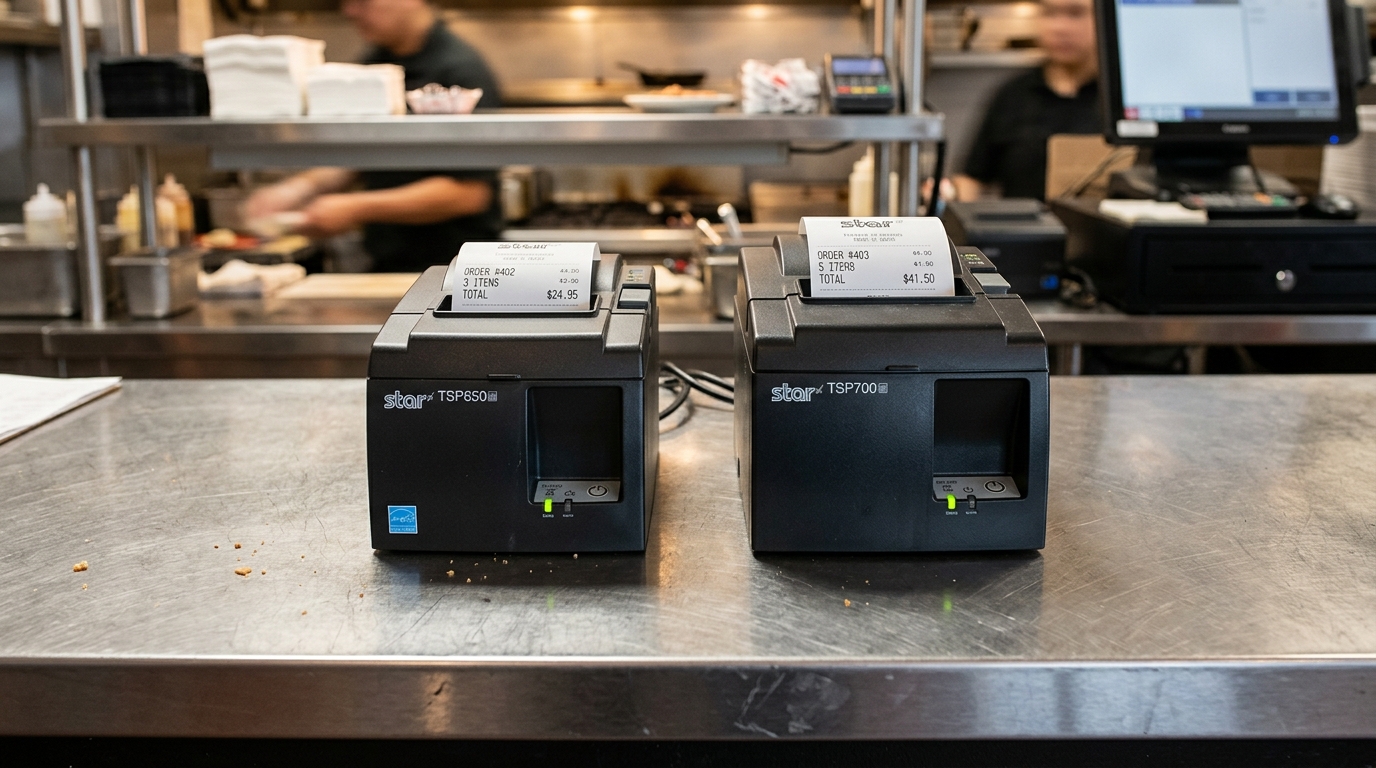
Star Micronics TSP650 vs TSP700: In-Depth Technical Comparison for POS Systems
Choosing the right thermal receipt printer is a critical decision for any retail, hospitality, or logistics business. Star Micronics is an industry leader, known for reliability.
And innovative software integration. Within their extensive lineup, the TSP650 (specifically the TSP654II).
And the TSP700 (specifically the TSP743II) series are two of the most commonly deployed models. While they may appear similar externally—both offering fast, high-quality thermal printing.
And robust connectivity—they are engineered for entirely different operational environments and volume requirements. Understanding the technical nuances, mechanical durability, and specific feature sets of each model is essential to ensure your Point of Sale (POS) system operates efficiently without overspending on unnecessary capabilities or under-equipping a high-volume checkout.
The primary distinction between the TSP650. And the TSP700 lies in their intended use cases.
The TSP650 is the quintessential "all-rounder." It is designed for standard retail environments, quick-service restaurants,. And ticketing applications where speed.
And reliability are paramount, but the printer is not subjected to extreme physical abuse or continuous, 24/7 high-volume operation. It balances cost-effectiveness with excellent performance.
The TSP700, on the other hand, is a heavy-duty workhorse. It is engineered with a more robust chassis, a higher-torque motor assembly, and the ability to handle thicker media types, making it the premier choice for demanding environments like high-volume lottery printing, secure ticketing, and industrial label applications.
This comprehensive comparison will dissect the technical specifications, mechanical design, media handling capabilities,. And connectivity options of both the TSP650. And TSP700 series, providing a definitive guide on which model you should buy based on your specific operational needs.
Detailed Technical Comparison
To make an informed decision, we must analyze the core specifications that dictate performance, longevity,. And versatility in a POS environment. The differences go far beyond basic print speed.
Print Speed. And Throughput: Both models boast impressive print speeds,.
But the TSP700 edges out the TSP650. The TSP654II prints at a rapid 300mm per second (approx.
60 receipts per minute). This is more than sufficient for 95% of standard retail scenarios.
However, the TSP743II operates at a blisteringly fast 250mm to 300mm per second (depending on the exact sub-model. And interface), but its primary advantage is sustained throughput.
Its processing logic and larger internal buffer allow it to handle complex graphics, barcodes, and long receipt batches with less pausing between prints, minimizing bottlenecks at high-traffic checkout lanes.
Media Handling. And Versatility: This is where the TSP700 significantly distinguishes itself.
The TSP650 is designed primarily for standard thermal receipt paper (typically 58mm or 80mm width, up to 85 micrometers thick). It handles standard receipts flawlessly.
The TSP700 is a multi-functional device. It features a heavy-duty print head.
And a more powerful feed mechanism capable of handling much thicker media—up to 150 micrometers. This means the TSP700 can print on standard receipts, thick event tickets, lottery stock,.
And even thermal labels with a black mark sensor for precise indexing. If your business needs to print anything thicker than a standard grocery store receipt, the TSP700 is the mandatory choice.
Mechanical Durability. And Reliability (MCBF): Mean Cycles Between Failures (MCBF) is a critical metric for POS hardware.
The TSP650 is a durable machine, boasting an MCBF of 60 million lines. And an auto-cutter life of 2 million cuts.
This ensures years of reliable service in typical retail. The TSP700 is built like a tank.
It offers an identical MCBF for lines printed,. But its guillotine auto-cutter is rated for a massive 2 million cuts on thick paper, and its chassis is designed to withstand splash and dust ingress better than the 650 (though neither is fully waterproof).
The TSP700 also includes an integrated rear cover to protect cables from accidental unplugging in chaotic environments.
Connectivity. And Integration (WebPRNT/CloudPRNT): Both series offer standard interchangeable interfaces (Serial, Parallel, USB, Ethernet,.
And Bluetooth). However, modern cloud-based POS systems rely heavily on direct-to-cloud printing.
Both the TSP650. And TSP700 support Star's innovative WebPRNT (printing via HTTP requests from a browser) and CloudPRNT (the printer polls a cloud server for print jobs without needing a local PC).
When selecting either model, ensure you purchase the specific version (e.g., TSP654II HI X or TSP743II HI X) that includes the intelligent interface board required for these advanced cloud features.
Which Model Should You Buy? A Scenario Guide
- Standard Retail. And Boutiques (Winner: TSP650): If you run a clothing store, a gift shop, or a standard retail operation where the primary output is standard paper receipts, the TSP650 is the optimal choice. It provides exceptional speed, reliability,. And modern connectivity at a more accessible price point than the 700. There is no need to pay for thick-media handling capabilities you will never use.
- Quick Service Restaurants. And Cafes (Winner: TSP650): For printing front-of-house customer receipts or simple order tickets for the barista, the TSP650 excels. It is fast enough to keep lines moving. And small enough to fit on crowded countertops. (Note: For back-of-house kitchen environments, a dot-matrix printer like the SP700 is usually preferred over thermal printers, which fade in high heat).
- Ticketing, Cinemas,. And Events (Winner: TSP700): This is the TSP700's primary domain. Event tickets require thicker cardstock to feel premium. And resist tearing. The TSP700 handles 150-micron thick paper effortlessly. And features precise black mark sensors to ensure the print aligns perfectly on pre-printed ticket blanks. The heavy-duty cutter will cleanly slice thick stock millions of times without jamming.
- Lottery. And Secure Printing (Winner: TSP700): High-volume lottery terminals demand absolute reliability. And the ability to print on specific security paper. The robust mechanics of the TSP700, combined with its advanced driver options for secure data parsing, make it the standard for many government lottery installations globally.
- Industrial Labeling. And Logistics (Winner: TSP700): While dedicated label printers exist, the TSP700 is capable of printing on thermal label rolls. Its powerful motor can pull heavy label rolls,. And the thick media handling prevents jamming. This makes it a versatile hybrid solution for shipping desks or warehouses that need to print both packing slips. And shipping labels from a single device.
Advanced Considerations: Software and Maintenance
Both printers utilize Star Micronics' renowned "futurePRNT" software utility. This powerful tool allows administrators to centrally manage printer configurations, design custom receipt layouts, automatically add coupons or graphics to the bottom of receipts based on keywords,.
And configure virtual serial ports. The software experience is largely identical across both models, providing a unified management platform if you deploy a mix of 650s.
And 700s in a large enterprise.
From a maintenance perspective, both printers feature "Drop-In. And Print" paper loading, minimizing training time for new cashiers.
However, the TSP700 includes user-replaceable parts that go beyond the basic print head. The auto-cutter module on the TSP700 can be swapped out relatively easily if it dulls after years of cutting thick tickets, extending the overall life of the printer chassis significantly compared to consumer-grade devices where a cutter failure means replacing the entire unit.
When factoring in Total Cost of Ownership (TCO), the TSP650 has a lower initial acquisition cost. However, deploying a TSP650 in an environment it wasn't designed for (like thick ticketing) will lead to rapid print head degradation.
And cutter jams, resulting in costly downtime. And premature replacement.
Always align the hardware specifications with the physical demands of your operational workflow.
FAQ
Can I upgrade the interface on my TSP650 or TSP700 later?
Yes. Both the TSP650.
Do I need ink ribbons for these printers?
No. Both the TSP650 and TSP700 are Direct Thermal printers.
Are these printers compatible with Square, Shopify, or Toast?
Generally, yes, Star Micronics printers have incredibly broad compatibility. However, you must verify the specific interface required.
What does the "HI X" designation mean on some models?
The "HI X" (or CloudPRNT) models include a highly intelligent interface board with an embedded operating system. This allows the printer to communicate directly with web servers.