

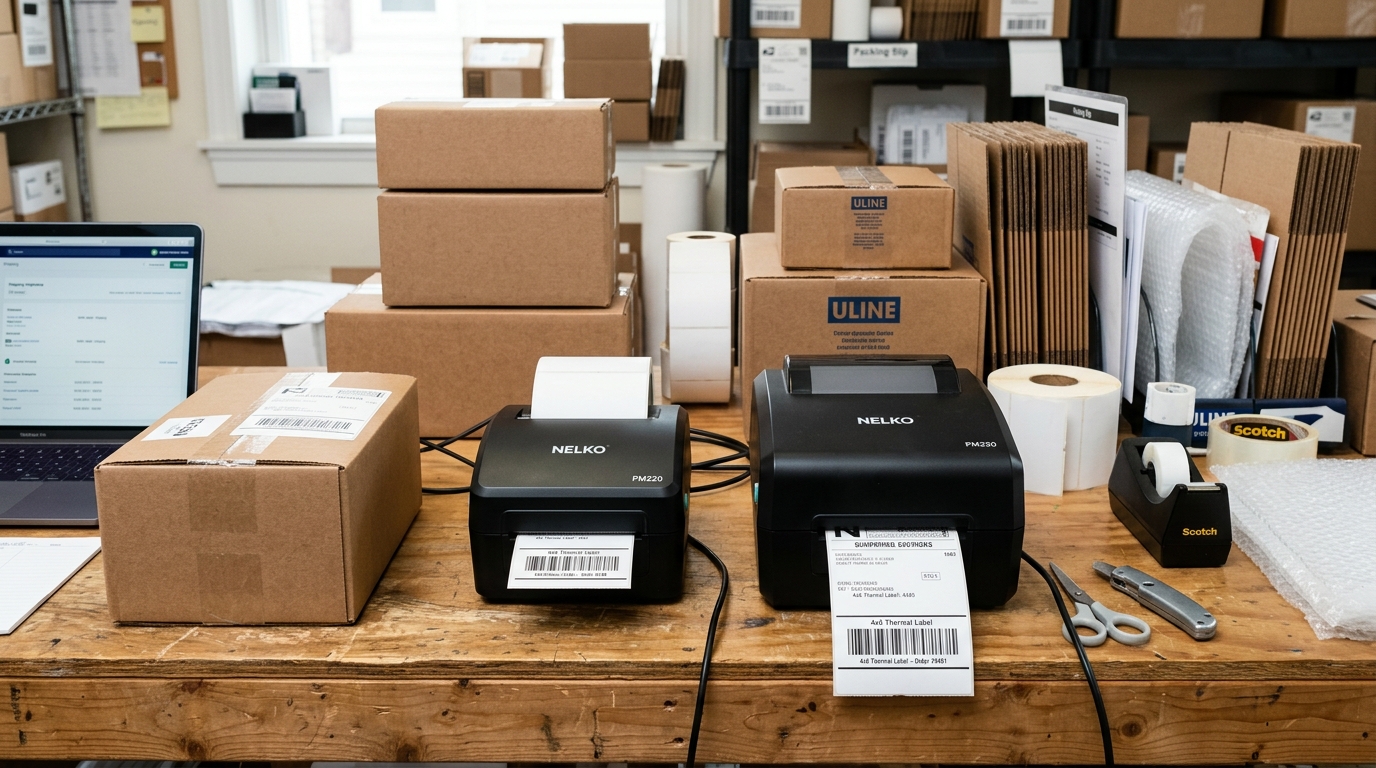
Introduction to Nelko PM220 and PM230
For small business owners, selecting the right thermal shipping label printer is a critical decision that impacts daily operational efficiency, shipping costs,. Overall workflow.
The Nelko PM220. PM230 have emerged as highly popular, cost-effective alternatives to established brands, offering robust feature sets including Bluetooth connectivity, high-speed thermal printing, and compatibility with a vast array of shipping platforms.
However, navigating the subtle differences between these two models. Successfully configuring them for a small business environment—particularly mastering the sometimes finicky Bluetooth pairing process—can be a daunting task for non-technical users.
This comprehensive guide provides an exhaustive comparison of the Nelko PM220. PM230, detailing their hardware specifications, target use cases, and step-by-step setup instructions to ensure your shipping station runs smoothly.
Whether you are printing labels for your boutique Etsy shop. Fulfilling hundreds of Amazon orders daily, understanding how to properly deploy and troubleshoot these wireless thermal printers will save you valuable time and reduce frustrating technical bottlenecks.
Why This Happens: The Technical Breakdown of Bluetooth Issues
Bluetooth pairing issues with thermal printers like the Nelko PM220. PM230 often stem from the complexities of modern wireless protocols and the specific ways operating systems handle Bluetooth peripheral connections.
These printers typically utilize Bluetooth Classic (BR/EDR) for maintaining a stable data stream necessary for transmitting high-resolution label graphics, alongside Bluetooth Low Energy (BLE) for discovery. Initial pairing handshakes.
When pairing fails, it is frequently due to protocol mismatches, where a smartphone. Computer attempts to connect using an incompatible profile (like trying to treat the printer as an audio device instead of a Serial Port Profile or generic data peripheral).
Furthermore, wireless interference plays a massive role; in a typical small business environment crowded with Wi-Fi routers, microwaves,. Other Bluetooth devices operating on the heavily congested 2.4 GHz ISM band, packet loss during the critical pairing handshake can cause the connection to drop prematurely or fail to initialize entirely.
Another major contributing factor is the operating system's Bluetooth stack management. Both iOS.
Android, as well as Windows and macOS, cache Bluetooth MAC addresses and device capabilities to speed up future connections. If a previous pairing attempt failed or was interrupted, the cached data might become corrupted.
Consequently, every subsequent attempt to connect to the Nelko printer relies on this flawed cache, resulting in a continuous loop of connection errors, "device not found" messages,. The dreaded "pairing rejected by PM220/PM230" alert.
Additionally. Many users attempt to pair the printer directly through the phone's native Bluetooth settings menu rather than through the dedicated Nelko printing application.
Thermal label printers often require the specific application to handle the exact data formatting. API calls to bridge the hardware and software; bypassing the app and pairing natively often leads to a "connected" status in the OS, but an inability to actually send print jobs because the necessary printing service wasn't properly invoked by the application.
Moreover, the difference between the PM220 and PM230 lies partly in their firmware (internal software) (internal software) handling of multi-device connections. While they advertise Bluetooth capability, they are generally not designed for simultaneous multipoint connections like high-end wireless headphones.
If the printer is currently paired. Actively connected to a tablet, attempting to pair a second device (like a smartphone) will usually fail until the first device drops the connection.
This "exclusive lock" behavior is a common source of confusion in small office settings where multiple employees might need to print labels from different devices throughout the day. Understanding this limitation is crucial for establishing a functional workflow.
Step-by-Step Fix and Setup Guide
- Physical Setup and Calibration: Unbox your Nelko PM220 or PM230. Connect the power adapter to the printer and plug it into a reliable surge protector. Load your 4x6 thermal labels, ensuring the printable side is facing up. Turn the printer on. Before attempting any Bluetooth connection, force a manual calibration. Press and hold the feed button on the printer until it beeps once, then release. The printer will feed several labels to learn the gap spacing. This ensures that when you do print, the label won't be misaligned.
- Clear Previous Bluetooth Caches: On the device you intend to print from (smartphone, tablet,. PC), navigate to the Bluetooth settings. Locate any previous entries for "PM220", "PM230", or generic printer identifiers. Select them and choose "Forget This Device" or "Unpair". Next, turn the Bluetooth toggle on your device off completely, wait ten seconds, and turn it back on. This resets the local Bluetooth radio stack.
- Download the Official Application: Do not attempt to pair the printer via your device's native Bluetooth settings yet. First, download the official "Nelko" app from the Apple App Store (for iOS devices). The Google Play Store (for Android devices). For Windows or Mac, download the official driver and software package from Nelko's support website.
- Initiate Pairing Through the App: Open the Nelko application. Ensure your device's Bluetooth is enabled. Grant the app all requested permissions, specifically "Location" (which is required by Android to scan for Bluetooth Low Energy devices) and "Bluetooth/Nearby Devices". Navigate to the printer connection section within the app.
- Select and Connect: Tap on "Add Printer" or the search icon within the app. The app will scan for nearby devices. Your PM220 or PM230 should appear in the list. Tap the printer name to initiate the connection. The app will negotiate the connection protocols automatically. If prompted for a PIN code during this process, try standard defaults like "0000". "1234", though the Nelko app usually bypasses this requirement programmatically.
- Verify. Test Print: Once the app indicates a successful connection (usually indicated by a green checkmark or connected status), load a sample shipping label or use the app's built-in test print function. Send the print job. If the label prints correctly and aligns well, your setup is complete.
- PC/Mac Bluetooth Setup (Alternative): If setting up on a computer via Bluetooth instead of USB, you MUST pair it through the OS settings first, THEN install the driver. Assign the specific incoming Bluetooth COM port to the printer queue. This is more complex than the mobile app setup. Go to Windows Settings -> Bluetooth & devices -> Add device. Select the printer. Once paired, open "Printers & scanners", add the printer manually,. Ensure the port is set to the virtual COM port created by the Bluetooth connection, not a generic LPT or USB port.
Advanced Troubleshooting
When the standard setup fails, you need to employ more aggressive diagnostic techniques. If the printer is simply not broadcasting its Bluetooth signal (it doesn't show up on any device's scan).
Perform a factory reset on the printer hardware itself. While the exact procedure can vary slightly by firmware (internal software) (internal software) revision.
It typically involves turning the printer off, holding down the feed button, turning the printer back on while continuing to hold the feed button for roughly 10-15 seconds until the indicator light flashes a specific sequence (often red/blue alternating). This clears the printer's internal NVRAM.
Resets the Bluetooth module to its factory state, eliminating any software-level hangs preventing broadcast.
If you are experiencing agonizingly slow print speeds over Bluetooth (e.g., a single label takes 30 seconds to transmit. Print, stopping and starting mid-print), the issue is almost certainly signal interference or a weak connection.
Bluetooth has a theoretical range of 33 feet, but in practice, walls, metal shelving, and other electronics drastically reduce this. Move your host device to within 3 feet of the printer and try again.
Additionally, check for firmware (internal software) (internal software) updates within the Nelko app. Manufacturers often release silent firmware (internal software) (internal software) patches that significantly improve Bluetooth stability and transmission efficiency.
Updating the firmware (internal software) (internal software) is a critical step for long-term reliability.
For Windows users dealing with Bluetooth COM port nightmares, open the "Device Manager". Look under both the "Bluetooth" category and "Ports (COM & LPT)".
If you see yellow exclamation marks next to the Nelko device. The standard Serial over Bluetooth link, you have a driver conflict at the OS level.
Right-click. Uninstall these devices, reboot the computer, and allow Windows to reinstall the generic Bluetooth enumeration drivers before attempting to pair the printer again.
Sometimes. Manually assigning a lower COM port number (e.g., COM3 instead of COM14) in the advanced port settings can resolve issues with legacy printing spoolers that struggle with high port numbers.
Frequently Asked Questions (FAQ)
What is the main difference between the Nelko PM220 and PM230?
The primary differences between the PM220. PM230 revolve around subtle design changes, printing speed optimizations, and slightly different paper handling mechanisms.
Can I connect multiple computers to one Nelko printer via Bluetooth at the same time?
No, you generally cannot maintain active, simultaneous connections from multiple devices via Bluetooth to a single PM220 or PM230. Bluetooth relies on a one-to-one master/slave relationship for data transmission in this context.
Why does the printer skip labels or print half a label over Bluetooth?
Skipping labels. Printing misaligned text is rarely a Bluetooth transmission error; it is almost always a calibration or paper size issue.
Is it better to use USB or Bluetooth for a small business setup?
For absolute reliability. The fastest possible printing speeds—especially if you are printing batches of 50+ labels at a time—a direct USB connection is superior.