


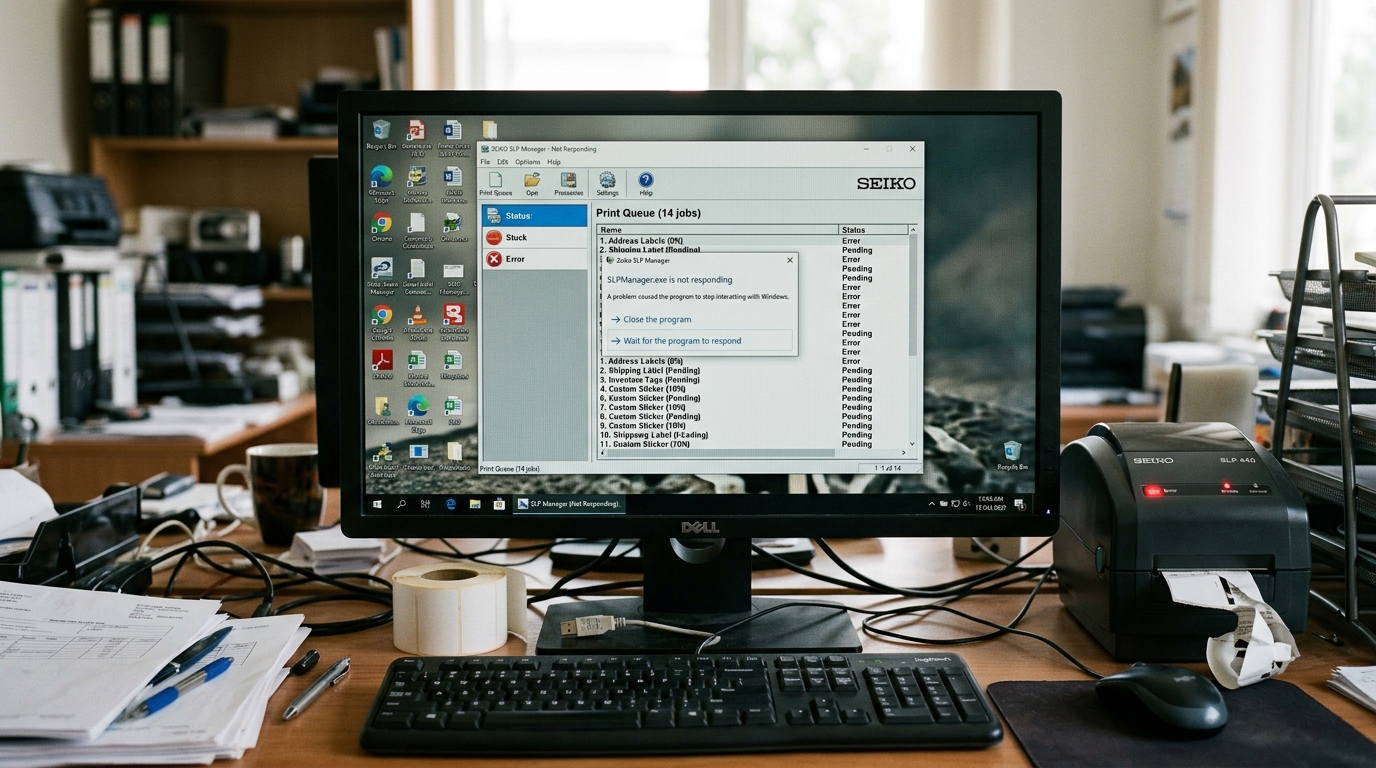
Welcome to our comprehensive technical guide on Fix Seiko SLP Manager Software Printer Not Responding or Stuck. When dealing with Seiko Smart Label Printer (SLP) not responding or stuck in the SLP Manager software.
It is essential to approach the situation with a structured troubleshooting methodology. Modern printing equipment relies on a complex interplay between hardware sensors, firmware (internal software) logic, and host device drivers.
A failure at any of these layers can result in the exact issue you are facing. In this detailed article, we will explore the root causes of this problem.
Dissect the underlying electromechanical processes, and provide you with actionable, step-by-step solutions to restore full functionality. Understanding the exact nature of this malfunction not only helps in resolving the immediate issue.
Also equips you with the knowledge to prevent future occurrences. As we explore the diagnostic process, we will cover both basic user-level fixes and advanced administrative configurations.
By the end of this guide, you will have a thorough understanding of. The diagnostic procedures required to maintain optimal performance and longevity for your equipment.
Our goal is to empower you with professional-grade troubleshooting techniques that go beyond superficial fixes. Ensuring a stable and reliable printing environment for your critical tasks.
In many enterprise and prosumer environments, downtime caused by printer errors translates directly to lost productivity and potential revenue impact. Therefore, addressing issues like Seiko Smart Label Printer (SLP) not responding.
Stuck in the SLP Manager software promptly and correctly is of paramount importance. We highly recommend reading through the entire diagnostic breakdown before attempting the fixes.
As certain steps may require administrative privileges or specific environmental conditions. Furthermore, maintaining an updated backup of your current configurations.
Driver settings is always a best practice before initiating deep system changes. Let's begin our deep dive into the mechanics of this issue and explore the definitive solutions.
Why This Happens
To fully grasp why Seiko Smart Label Printer (SLP) not responding. Stuck in the SLP Manager software occurs, we must examine the internal architecture of the printing system.
At its core, a printer is an intricate network of stepper motors, thermal elements, optical sensors, and microcontrollers. When a print job is initiated, the host system translates the digital document into a rasterized image.
A series of vector commands, which are then transmitted via USB, network, or Bluetooth interfaces. The printer's internal logic board receives this data, buffers it in its volatile memory, and begins executing the mechanical sequence.
If there is a disruption during this data transmission phase—such as packet loss, buffer overflow. An interruption in the continuous data stream—the printer may enter a halted state, triggering the error you are experiencing.
Another critical factor is thermal and power management. High-performance printers generate significant heat, especially those utilizing thermal print heads or rapid mechanical actuation.
To prevent catastrophic hardware failure, manufacturers implement thermal throttling and power-gating mechanisms. If the ambient temperature is too high, or if the printer is subjected to a continuous.
Dense workload without adequate cooling intervals, the internal thermistors will register an over-temperature condition. This immediately prompts the firmware (internal software) to suspend operations.
Often resulting in an unresponsive state or a specific error code. Furthermore, mechanical wear and tear, such as dust accumulation on optical encoders.
Degradation of the rubber feed rollers, can cause micro-slippage. The system detects this discrepancy between expected motor rotation and actual paper movement.
Interpreting it as a jam or hardware fault, which also leads to this specific problem. Understanding these hardware-level triggers is crucial for accurate diagnosis.
Step-by-Step Fix
Follow these detailed, numbered steps to systematically isolate and resolve the issue. Please perform each step in the exact order presented, as they are. Arranged from the most common and least intrusive fixes to more involved procedures.
- Restart the Print Spooler: Open the Windows Services console (services.msc), locate the Print Spooler service, and restart it to clear stalled jobs. Start by ensuring the device is in a safe state. Disconnect any active data cables and power down the unit completely. Wait for at least 60 seconds to allow the internal capacitors to discharge. Once powered back on, observe the setup sequence. This soft reset often clears transient memory errors that may be causing the issue. If the problem persists, proceed to verify the integrity of your connection mediums. Inspect cables for physical damage or replace them with certified high-throughput cables. For wireless connections, analyze the signal-to-noise ratio and ensure there is. No interference from other devices operating on the same frequency band. Additionally, verify that the host machine's operating system is fully up to date. That there are no pending system updates that could interfere with peripheral communication. It is also advisable to clear the local print spooler, which can. Sometimes harbor corrupted print jobs that continuously crash the driver service upon connection.
- Reinstall SLP Manager: Completely uninstall the Seiko SLP Manager software, restart your computer, and install the latest version from the official website. Start by ensuring the device is in a safe state. Disconnect any active data cables and power down the unit completely. Wait for at least 60 seconds to allow the internal capacitors to discharge. Once powered back on, observe the setup sequence. This soft reset often clears transient memory errors that may be causing the issue. If the problem persists, proceed to verify the integrity of your connection mediums. Inspect cables for physical damage or replace them with certified high-throughput cables. For wireless connections, analyze the signal-to-noise ratio and ensure there is. No interference from other devices operating on the same frequency band. Additionally, verify that the host machine's operating system is fully up to date. That there are no pending system updates that could interfere with peripheral communication. It is also advisable to clear the local print spooler, which can. Sometimes harbor corrupted print jobs that continuously crash the driver service upon connection.
- Check USB Port and Cable: Plug the printer directly into a motherboard USB port on. The back of the computer, avoiding USB hubs or front panel ports. Start by ensuring the device is in a safe state. Disconnect any active data cables and power down the unit completely. Wait for at least 60 seconds to allow the internal capacitors to discharge. Once powered back on, observe the setup sequence. This soft reset often clears transient memory errors that may be causing the issue. If the problem persists, proceed to verify the integrity of your connection mediums. Inspect cables for physical damage or replace them with certified high-throughput cables. For wireless connections, analyze the signal-to-noise ratio and ensure there is. No interference from other devices operating on the same frequency band. Additionally, verify that the host machine's operating system is fully up to date. That there are no pending system updates that could interfere with peripheral communication. It is also advisable to clear the local print spooler, which can. Sometimes harbor corrupted print jobs that continuously crash the driver service upon connection.
- Clear the AppData Folder: Navigate to the hidden AppData folder and delete the. Seiko SLP settings files to reset the software to default settings. Start by ensuring the device is in a safe state. Disconnect any active data cables and power down the unit completely. Wait for at least 60 seconds to allow the internal capacitors to discharge. Once powered back on, observe the setup sequence. This soft reset often clears transient memory errors that may be causing the issue. If the problem persists, proceed to verify the integrity of your connection mediums. Inspect cables for physical damage or replace them with certified high-throughput cables. For wireless connections, analyze the signal-to-noise ratio and ensure there is. No interference from other devices operating on the same frequency band. Additionally, verify that the host machine's operating system is fully up to date. That there are no pending system updates that could interfere with peripheral communication. It is also advisable to clear the local print spooler, which can. Sometimes harbor corrupted print jobs that continuously crash the driver service upon connection.
In addition to the aforementioned points, it is critical to evaluate the overall ecosystem in which your device operates. Hardware peripherals do not function in a vacuum; they interact closely with the operating system's hardware abstraction layer.
When diagnostic efforts stall, professionals often turn to analyzing the entire stack—from the application layer down to the physical connection. Understanding how data moves through the print spooler, gets serialized by the USB.
Network stack, and is finally interpreted by the printer's microcontroller can provide invaluable insights. For instance, sometimes the issue isn't the printer itself but a corrupted DLL file.
Within the operating system that handles the specific rasterization process required by the printer's driver. Regular maintenance, such as disk cleanups, registry integrity checks, and ensuring that no conflicting software.
Is vying for control over the same peripheral ports, forms the bedrock of a stable system.
Furthermore, user training plays a significant role in preventing operational errors. Many hardware faults are the direct result of improper handling.
Such as forcibly removing paper jams without releasing the mechanical locks. Or using incorrect media types that leave excessive residue on the feed rollers.
Educating the end-users on the correct operational procedures and basic troubleshooting steps can drastically reduce the incidence of critical failures. Documenting the specific configurations and any unique environmental factors that affect your setup will also.
Aid in future diagnostic efforts, creating a valuable knowledge base tailored to your specific deployment.
Advanced Troubleshooting
If the standard step-by-step procedures have not resolved the issue with Seiko Smart Label Printer (SLP) not responding. Stuck in the SLP Manager software, it is time to move into advanced troubleshooting territory.
This phase involves deep system diagnostics and potential hardware inspection. First, consider the firmware (internal software) level.
Outdated or corrupted firmware (internal software) can cause a multitude of inexplicable errors. Visit the manufacturer's official support portal and download the latest firmware (internal software) payload.
Apply this update using a hardwired connection and a reliable. Power source to prevent bricking the device during the flash process.
Be aware that firmware (internal software) updates can sometimes alter default configurations. Be prepared to reapply your specific network or print density settings post-update.
Sometimes, the SLP Manager software conflicts with other label printer drivers installed on the same system (e.g., Dymo or Zebra). Using a tool like Microsoft Sysinternals Process Monitor (ProcMon), you can trace the SLP Manager executable to.
See if it is hanging while trying to access a specific registry key or hardware polling address. Isolating these conflicts may require registry editing or running the software in a sandboxed environment.
On the software side, we must investigate the operating system's handling of the printer driver. Open the Event Viewer (Windows) or the Console app (macOS) and filter the system logs for peripheral or driver-related errors.
You are looking for specific hexadecimal error codes or timeout warnings that correlate with the exact time the printer failed. Often, aggressive power-saving features implemented by the OS (such as USB Selective Suspend).
Can inadvertently sever the connection to the printer, causing it to drop offline silently. Disabling these power management features in the Device Manager or through registry modifications can provide a more stable communication channel.
In extreme cases, a complete manual eradication of the printer drivers—including deleting residual registry keys. System folders—followed by a clean installation in Safe Mode, may be required to resolve deep-seated driver conflicts.
Finally, consider the physical environment. Printers are sensitive to extreme humidity and temperature variations, which can affect paper path friction and sensor accuracy.
Ensure the printer is operating within the manufacturer's specified environmental tolerances. If you have ruled out all software and environmental factors, there may be a physical hardware defect.
Such as a failing mainboard or a degraded internal power supply, requiring professional repair or part replacement.
FAQ
Here are some frequently asked questions regarding this issue, providing quick answers to common concerns.
Why does SLP Manager say "Printer Not Found"?
This usually indicates a USB communication failure, either due to a bad cable. Incorrect port, or corrupted USB host controller drivers.
Can I use third-party software with the Seiko SLP?
While SLP Manager is the official software, Seiko printers can often be. Used with generic label printing software if the correct Windows drivers are installed.
Does SLP Manager work on Windows 11?
Yes, but older versions of the software may require compatibility mode. Always ensure you have the latest release.
What happens when jobs get stuck in the queue?
The queue becomes backed up, preventing new jobs from reaching the printer until the spooler service is manually reset. Understanding this aspect is vital for long-term maintenance and optimal operation of your device.
To summarize, dealing with Seiko Smart Label Printer (SLP) not responding or stuck in the SLP. Manager software requires a methodical approach that encompasses hardware inspection, firmware (internal software) validation, and software settings.
By following the comprehensive steps outlined in this guide. You should be well-equipped to restore your printer to full operational status.
Remember that preventative maintenance is just as important as reactive troubleshooting. Regularly cleaning the internal components, keeping your drivers and firmware (internal software) up to date.
Ensuring a stable power supply will significantly reduce the likelihood of encountering such issues in the future. We hope this in-depth technical analysis has provided you with the clarity and actionable solutions necessary to overcome this challenge.
Keep this guide bookmarked for future reference, and do not hesitate to. Revisit the advanced troubleshooting section should the problem resurface under different operating conditions.