


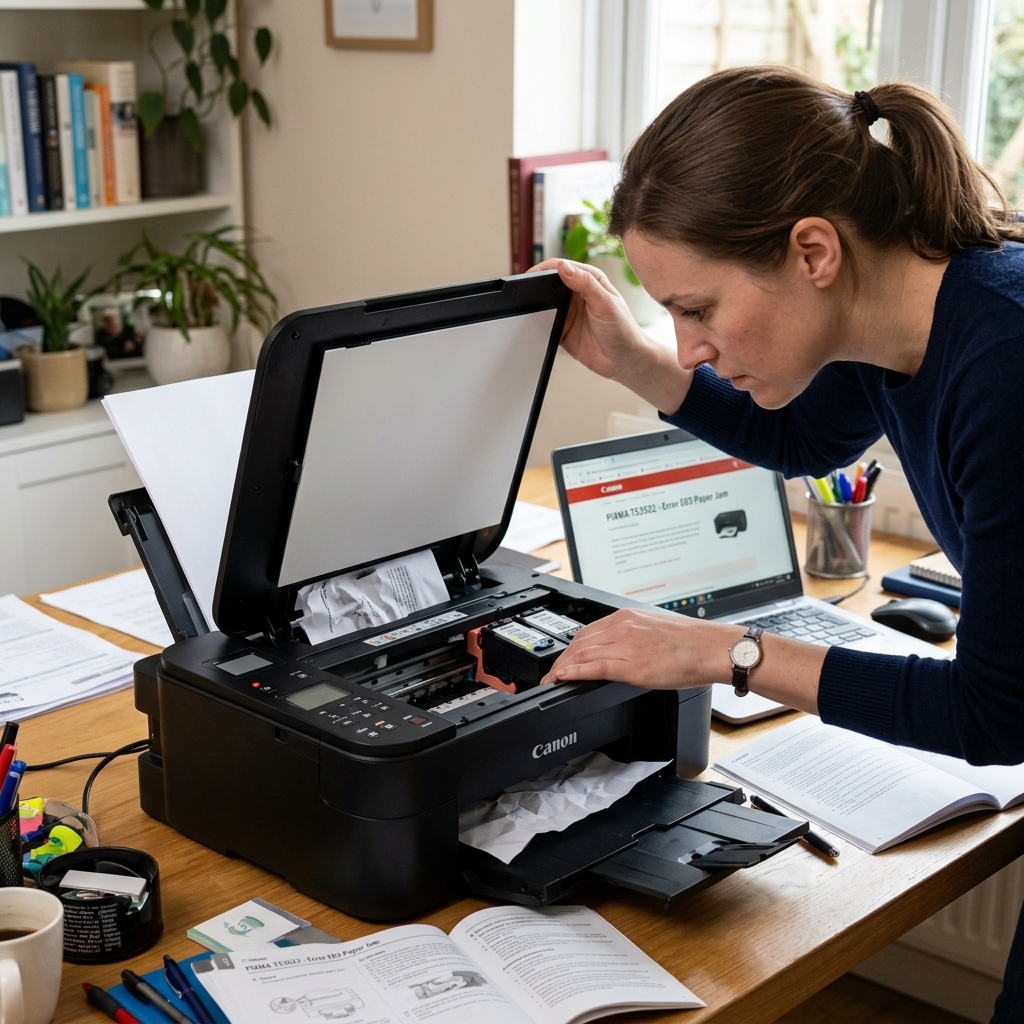
Troubleshooting Canon PIXMA TS3522 Not Printing Issues
The Canon PIXMA TS3522 is a highly popular, budget-friendly wireless printer designed for home use. Despite its simplicity.
Users frequently face frustrating scenarios where the printer refuses to print, either sitting completely unresponsive or churning out blank pages. Diagnosing a TS3522 requires looking at its wireless settings, its dual-cartridge system.
And The status of its somewhat cryptic LED indicator lights.
Printers are highly complex electro-mechanical devices. This means that Rely on a delicate symphony of software drivers, network protocols, and precision hardware to function correctly.
When one of these components falls out of alignment or encounters an unexpected state. The system halts to prevent physical damage or data corruption, resulting in the issue you are experiencing.
Understanding the underlying architecture of your printer's communication stack is essential for effective troubleshooting.
In this comprehensive guide, we will break down the exact sequence of events that leads to this failure. We will explore the mechanical triggers, the software miscommunications, and the network topology issues that contribute to the problem.
By following the systematic diagnostic approach outlined below. You will not only resolve the immediate error but also optimize your printer's settings to prevent future occurrences, ensuring long-term reliability and optimal performance.
Why This Happens
If the TS3522 is outputting blank pages. The most common cause is the protective tape being left on the bottom of the PG-275 or CL-276 ink cartridges, physically blocking the microscopic nozzles.
If the printer is completely unresponsive, it has likely lost its connection to your Wi-Fi router. The TS3522 only supports 2.4GHz Wi-Fi networks.
If your router recently updated or merged its 2.4GHz and 5GHz bands (Band Steering), the printer will drop off the network. Additionally.
The 'Paper' and 'Warning' LED lights on the top panel flash in specific sequences to indicate exactly what is wrong, such as a paper size mismatch or an empty cartridge.
Additionally, external environmental factors and usage patterns play a significant role. Fluctuations in ambient temperature and humidity can affect paper curl and ink viscosity, leading to internal sensor faults.
Power surges or micro-interruptions can corrupt the volatile memory within the printer. Scrambling the active print queue and causing logic board desynchronization.
Step-by-Step Fix
- Open the front access door and remove both ink cartridges. Verify that all clear or orange protective tape has been removed from the copper contacts and the print nozzles.
- If the printer is offline. Press and hold the 'Network' button on the printer until the screen flashes, then press the WPS button on your home router to re-establish the Wi-Fi connection.
- Check the LCD screen for error codes (e.g.. E03 for paper jam, E05 for cartridge not recognized) and press the 'Black' or 'Color' copy button to attempt to clear transient warnings.
- On your computer or smartphone, open the Canon PRINT Inkjet/SELPHY app and check the printer status. If it shows offline, remove the printer from your device and re-add it to refresh the IP route.
After completing these specific steps, it is crucial to perform a full power cycle. Disconnect the printer's power cord directly from the wall outlet—do not just use the power button.
Wait at least 60 seconds to allow the internal capacitors to fully discharge. This clears the volatile RAM and forces the printer to initialize all sensors and mechanical components from a cold state when plugged back in.
Advanced Troubleshooting: Deep Dive Diagnostics
When basic fixes fail to resolve the error on your printer, it is time to perform advanced system-level diagnostics. This involves examining the underlying network protocols, the operating system's print spooler mechanisms.
And The printer's internal firmware (internal software) state. Modern printers act as independent network nodes.
This Means they are susceptible to IP address conflicts, corrupted driver cache, and faulty routing tables.
In Windows environments, the Print Spooler service is responsible for managing all print jobs and communicating with the printer driver. Often, the spooler's queue becomes corrupted due to a sudden loss of communication or a malformed print job.
This Manifests as an offline state or an obscure error code. To manually clear and reset the spooler, you must bypass the GUI and use the Command Prompt with administrative privileges.
First, open the Start menu, type 'cmd', right-click Command Prompt, and select 'Run as administrator'. In the console, execute the command net stop spooler.
This forcefully halts the spooler service. Next, navigate to the spooler directory by typing del /Q /F /S "%systemroot%\System32\Spool\Printers\*.*".
This command deletes all pending print jobs, effectively clearing the corrupted queue without deleting your printer drivers. Once the directory is clear, restart the service with net start spooler.
This process often resolves persistent errors that survive a standard reboot.
For macOS users, the Common UNIX Printing System (CUPS) handles background printing operations. When a printer falls into an unrecoverable error state on a Mac.
Resetting the entire printing system is often the most effective solution. This clears out all configured printers, scanners, and pending jobs, allowing you to rebuild the connection from scratch.
To perform this reset, open System Preferences (or System Settings on macOS Ventura and later) and navigate to 'Printers &. Scanners'.
Hold down the Control key and click anywhere in the list of devices on the left side of the window. A context menu will appear with the option 'Reset printing system...'.
Select this option and authenticate with your administrator password. After the system is reset, it is highly recommended to restart the Mac before re-adding the printer.
When adding the printer back, ensure you are using the manufacturer's specific driver rather than the generic AirPrint driver. This Often lacks support for advanced diagnostic communication and ink level reporting.
Network connectivity is the foundation of modern wireless printing. If your printer and computer are on different subnets.
Or if the router's DHCP lease expires and assigns a new IP address to the printer, the operating system will lose track of the device. This is commonly referred to as an IP mismatch.
To permanently prevent this, you should configure a Static IP address for your printer.
Start by printing a Network settings Page directly from the printer's control panel. Locate the current IP address, Default Gateway, and Subnet Mask.
Open a web browser on a computer connected to the same network and enter the printer's IP address into the address bar to access the Embedded Web Server (EWS). Log in using the administrator credentials.
Navigate to the Network Settings or IPv4 settings page. Change the IP assignment method from 'Automatic (DHCP)' to 'Manual (Static)'.
Assign an IP address that is outside your router's active DHCP pool, but within the same subnet. Save the settings and restart both the printer and the router to establish a stable, permanent connection.
firmware (internal software) acts as the operating system of the printer itself. Manufacturers frequently release firmware (internal software) updates to patch security vulnerabilities, improve compatibility with newer operating systems.
And Fix internal software bugs that cause false error codes. Running outdated firmware (internal software) can lead to erratic behavior, including failure to wake from sleep mode, unresponsiveness.
And Incorrect ink level readings.
FAQ
Why is my TS3522 printing blank pages even with new ink?
The ink may not be flowing. Run a 'Deep Cleaning' cycle from the printer properties on your computer to force ink through the nozzles and clear any dried residue.
Does the TS3522 connect to 5GHz Wi-Fi?
No, the Canon TS3522 only contains a 2.4GHz wireless radio. Ensure your router is broadcasting a dedicated 2.4GHz SSID for the printer to connect to.
What do the flashing lights mean on my TS3522?
The number of flashes corresponds to a specific error. For example, 2 flashes usually means out of paper, 3 flashes means a paper jam.
